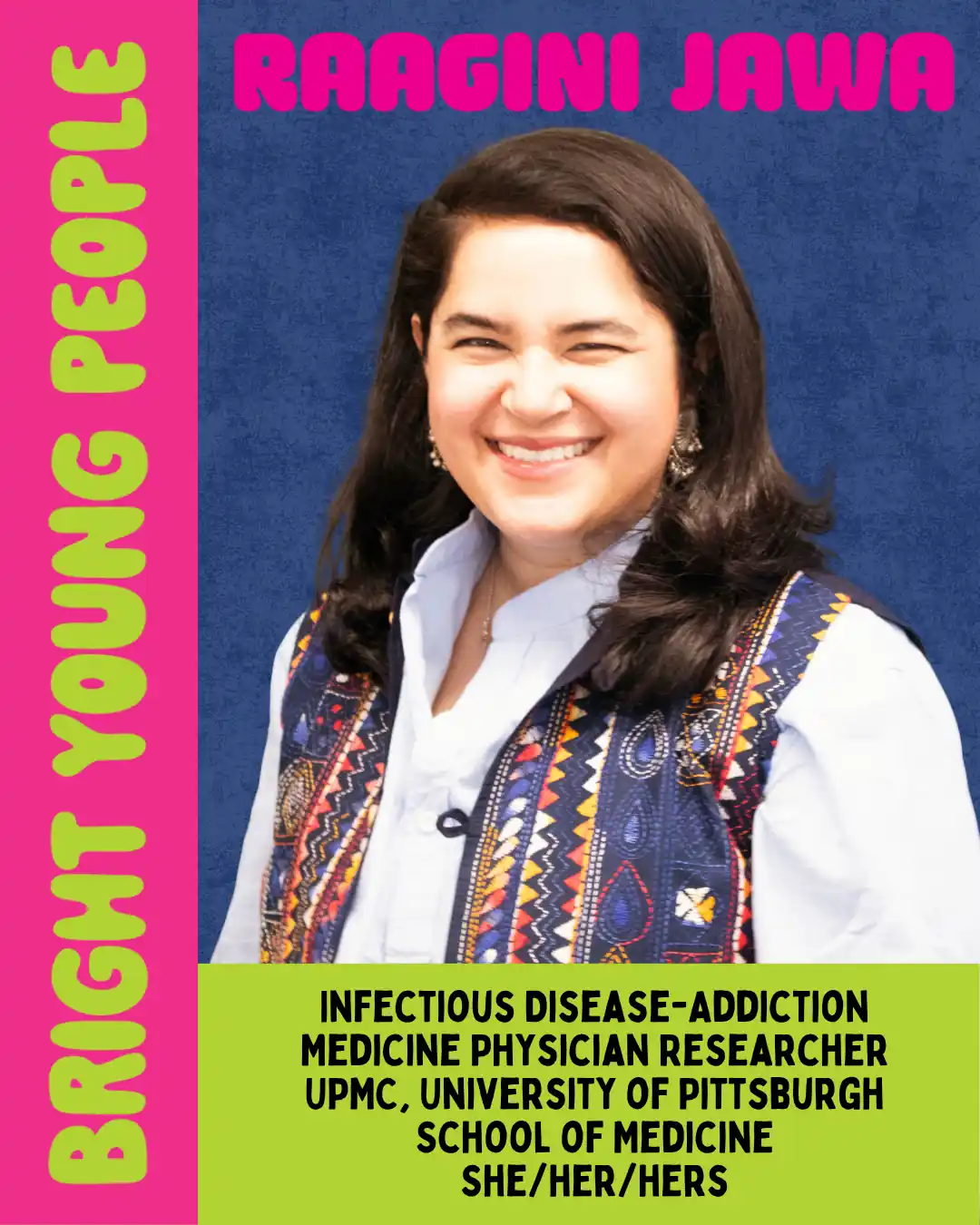
Raagini Jawa
she/her/hers
Infectious Disease-Addiction Medicine Physician Researcher,
UPMC and University of Pittsburgh School of Medicine
For Dr. Raagini Jawa, the intersection of infectious disease and addiction medicine felt like a natural fit.
“I have always been interested in trying to do public health or delivery of services for people with HIV who are underserved,” she said. “I think most people think that because HIV is a viral infection that is sexually transmitted that that is the primary route of transmission, but HIV is a bloodborne viral infection as well, so folks who engage in injection drug use are at really high risk.”
Raagini’s work combines primary care, infectious disease care and addiction care for her patients.
“I am a physician researcher, so I spend a portion of my time providing care for people who use substances, who are at risk of HIV and other infections, and I also spend a period of my clinical time providing infectious disease care in the hospital,” she said. “The rest of my time is leading a lab where we do research to normalize harm reduction.”
That lab, the Harm Reduction Research Collaborative, consists of faculty members, students and public health workers. The collaborative focuses on working with communities on research projects that normalize harm reduction services and aims to get rid of the siloing that exists between related fields, like HIV and addiction medicine.
“Some health services have been geared toward those who are more at risk of sexual transmission of this infection, and the other silo was for targeting people who use substances,” Raagini said. “The reality is these risk factors are often in the same people and the same community. By not addressing addiction in addition to sexual behaviors is doing a disservice to patients.”
Raagini has three major goals for her work moving forward.
The first is to mobilize policy makers to legalize access to harm reduction programs statewide. Pennsylvania currently is one of just seven states that has not legalized syringe exchange programs statewide, though there is no law preventing communities from authorizing their own programs.
The next is to scale her local efforts across the commonwealth, partnering with Centers for Excellence for Opioid Use Disorder so providers are more comfortable offering harm reduction services to their patients.
Finally, she hopes to build capacity with young people.
“I think there is a hunger for change in how we do things in public health and in medicine,” Raagini said. “We’re really excited to continue working with community members and students to change how we view preventing infections like HIV and substance use away from the narrative of stigma and othering and normalizing them to be part of the typical public health and medical trajectory.”
Because stigma surrounds both HIV and injection drug use, Raagini hopes to break down barriers to care for those who may feel othered in healthcare settings by normalizing harm reduction services alongside infectious disease care.
“There’s stigma even within the HIV community for this population,” Raagini said. “It isolates patients away from getting services from the traditional low-barrier clinics. That’s why it’s important for us to be mindful that we’re not othering this really vulnerable group of people that have already been othered by health systems. Often people who use substances are forgotten about.”
Though Raagini appreciates the recognition she’s received through the Bright Young People program, she stresses that it’s not work that she’s doing alone.
“The work that we do in our teams couldn't be done with just me alone,” she said. "This recognition speaks more for the partnerships and the hard work that is being done silently by our community members to try to change the narrative about how HIV prevention services and addition services need to be reshaped for health equity.
“I’m grateful to the patients that I serve, and I will continue to advocate on behalf of them throughout my career,” she continued. “I think as long as civilization will exist, sex and drugs will be stigmatized. We need more champions in the community to normalize this so there is better health equity for all patients.”