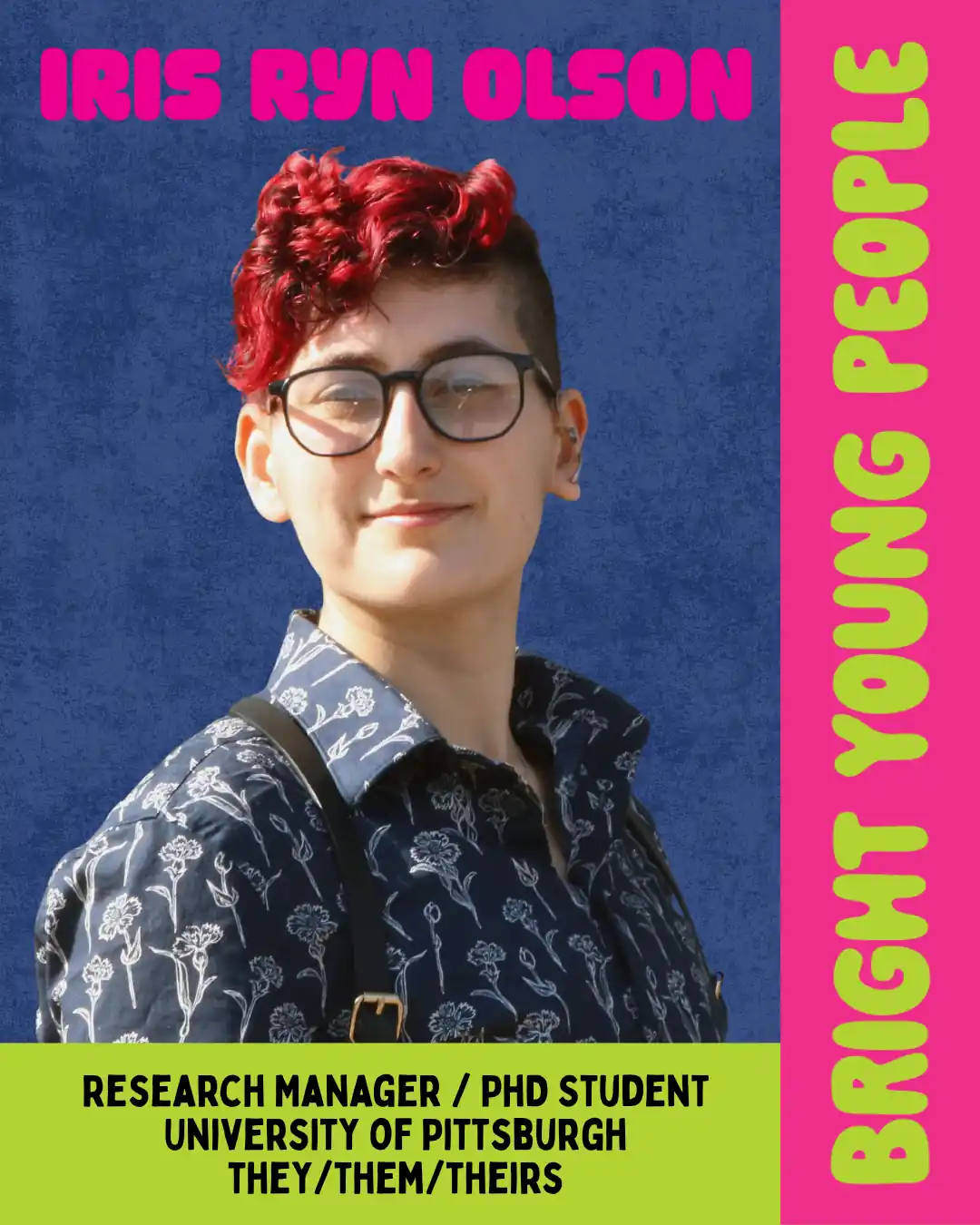
Iris Ryn Olson
they/them/theirs
research manager and PhD student, University of Pittsburgh
In the academic and healthcare realms, there can be a lack of information about – and for – specific marginalized and niche communities, and Iris Ryn Olson is working to address that across several different communities.
Iris works full time for EMBRACE and just health collaborative. With EMBRACE, Iris connects Black people experiencing pregnancy with postpartum resources to combat childbirth mortality, and with just health collaborative, they work to increase access to healthcare for people in the LGBTQIA+ community who have been incarcerated.
“EMBRACE is really focused here in Allegheny County, working with Black families, specifically during the postpartum period,” Iris said.
The postpartum period, which is sometimes called “the fourth trimester,” can be a particularly dangerous time for people who have given birth.
“We have one of the highest morbidity and mortality rates in the country, especially for black birthing people,” Iris said. “There’s a lot of death and a lot of health impacts that happen during that period. So many different forms of systemic issues lead to these health disparities.”
EMBRACE conducts community-based research, and as communications and dissemination coordinator, Iris presents that information to the community that’s taken part in and is impacted by the research.
“My role is to help support getting the research findings to the general public,” Iris said. “Most people are not going to sit down and read a peer reviewed research article. Seminars, social media, tabling at community events, make that information accessible. It’s about the community, and the community deserves to have information about themselves and their experiences.”
With just health collaborative, Iris is working with a different population.
"That is research pertaining to LGBTQ-identifying young adults who have previously been police involved and connecting them to HIV and addiction care,” Iris explained.
As if that wasn’t enough, Iris is working part time on their PhD, where they hope to do a dissertation on pregnant people involved in kink and BDSM and their experiences with healthcare.
“For this particular area of study, I have been involved in the kink and BDSM scene for over a decade at this point,” Iris said. “That particular population has been historically left out of the conversation. There’s this glaring gap when we start talking about access to healthcare – that area has just not been studied, and we don’t have scientific literature. There’s no resources for being pregnant while kinky.”
Iris notes that in kink culture, there is education and resources available for individuals to practice their kink safely, but people’s bodies change during pregnancy, and the current information frequently does not address that.
“In rope education, there’s a lot of education about joints, and blood flow,” Iris said. “Blood flow drastically changes during pregnancy, but that is not part of the education that’s seen in the rope scene.”
That is just one example of where their PhD work can provide insight, Iris said.
“Hopefully this research will point to what the community needs and what the community wants.”
Across all their work, Iris is committed to addressing gaps in care that face many people navigating the healthcare system.
“The healthcare system is not created to meet the needs of every population, and a lot of the work that I do is to identify the needs and wants and desires of those communities and get them the support that they need and the resources they desire,” they said. "There is work that is being done for a lot of different communities to help support their healthcare and their wellbeing, even in a political and a health climate that is not made for them. Work is being done, and I’m happy to be part of it.”