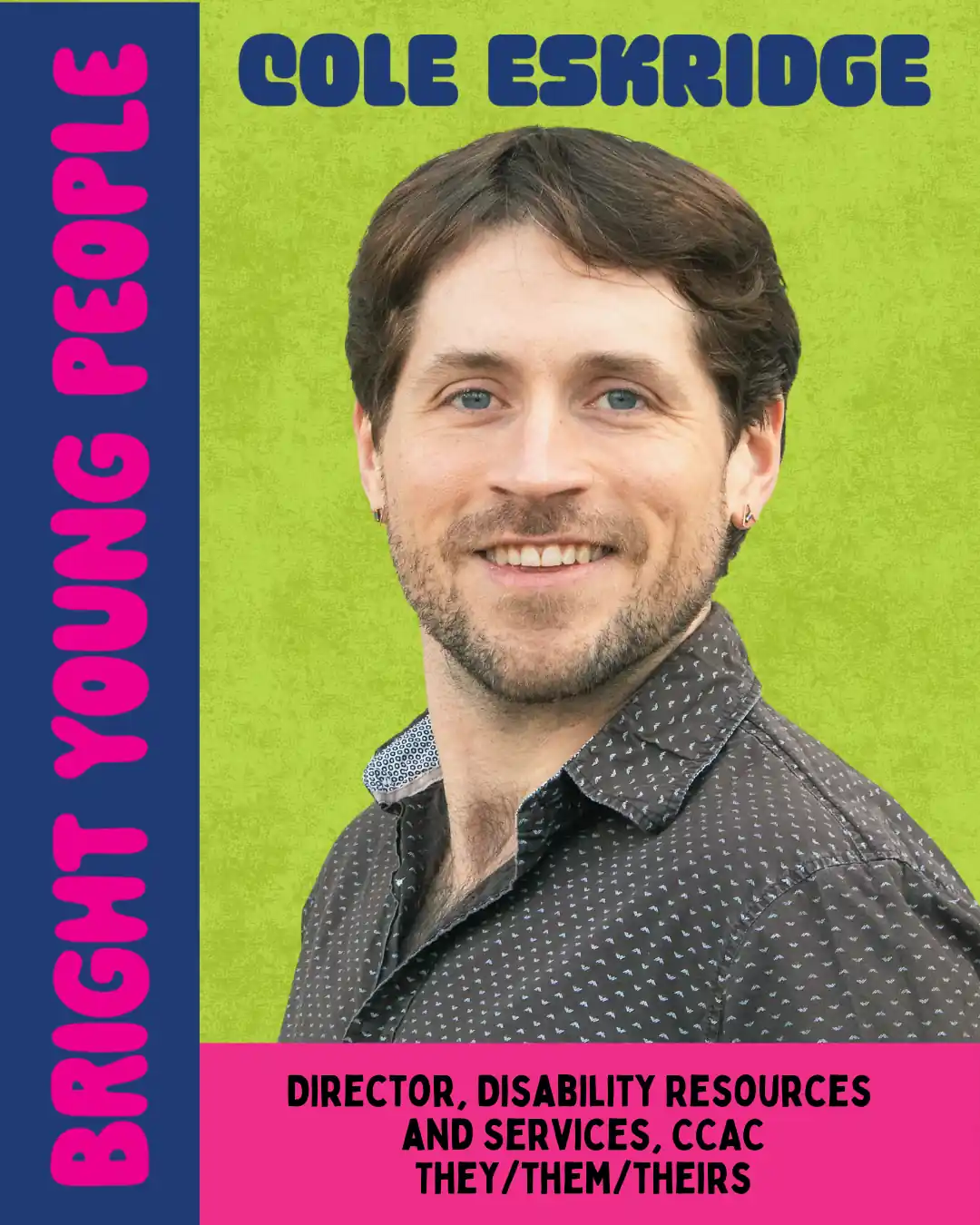
Cole Eskridge
they/them/theirs
Director, Disability Resources and Services, Community College of Allegheny County
Cole Eskridge was focusing on a completely different field – biology, specifically entomology – when an experience at a summer research program changed the course of their career.
“We had a summer research program where students in the Tucson area could come in and work with faculty and graduate students and research assistants to complete a project over the course of the summer,” they explained.
A student in the next lab used a wheelchair, and Cole noticed the challenges that student was experiencing.
“Science labs are famously not accessible,” Cole said. “Through that summer of being tangentially supportive of that student ... that kind of planted a seed. It led to many other programs I was involved in.”
Cole realized that they didn’t enjoy working in a lab, though they loved the experience of being on campus, so they pivoted to student affairs. They were hired to run the resource program for the University of Arizona’s LGBTQIA+ resource center. While there, Cole made accessibility a priority.
“Once you have that lens, it becomes a really powerful tool,” they said. “Universal design as a model can be used to improve and imbed access into whatever product, experience, course, event, program you’re designing.”
Though Cole did not formally study accessible design, they began noticing how many spaces are either not easily accessible or have clunky retrofitting.
“I can tell they did not ask someone how they could more easily or more naturally be inclusive,” they said, noting that when a person cannot access a space, they may feel excluded or be reluctant to reach out for support.
Cole moved to Pittsburgh to be closer to family, first working at Point Park University, and now at Community College of Allegheny County, where they are director of disability resources and services. Cole says they have put down deep roots here in Pittsburgh, and they’re planning to work to increase access to education, not just for students with disabilities but for members of the LGBTQIA+ community as well.
To that end, Cole is starting an Ed.D program at the University of Pittsburgh this summer.
“I hope to focus on college transition for disabled students, from high school into higher education,” they said. “I have no specific plan to leave disability resources any time soon.”
They also are looking at ways to include more LGBTQIA+ advocacy in their role at CCAC.
“Thinking how we can make some good trouble and highlight and find those spaces where queer and trans students can find each other, including employees and staff,” Cole said. “Their presence is valued here, and they are valuable in the education space as well.”
Cole helps bring that message to a wider audience as an active member of the American College Personnel Association and in their role as immediate past chair of ACPA’s Coalition for Sexuality and Gender Identities, which focuses on the support of trans and queer students in post-secondary education.
Whether it’s looking at ways to offer more accessible spaces to disabled students or space where LGBTQIA+ students can feel safe, inclusion is at the heart of Cole’s work.
“If there is any point of emphasis that I want people to understand is that inclusion is not a scary word,” Cole said. “It is not a difficult word, but it does take work. And the work is thinking ahead and considering folks who might experience the world differently from yourself and logically piecing together what those barriers are that would prevent them from being in community and sharing space. Any time we have that opportunity, let’s take it, and let’s do the work ahead of time.”